

Choisir les matériaux d'emballage pharmaceutique peut sembler être une simple décision d'achat. Or, il s'agit d'une démarche réglementaire complexe qui détermine la réussite de votre étude de stabilité, la résistance de votre lot au transport et l'acceptation de votre dossier par la FDA. Un mauvais choix de matériau engendre non seulement des coûts financiers, mais aussi des mois de qualification et parfois même l'annulation du lancement.
Le verre : matériau inerte par défaut pour les liquides et les injectables
Les flacons, ampoules et bouteilles en verre sont prédominants pour les produits injectables stériles, les produits lyophilisés et la plupart des formulations liquides. La raison: le verre est chimiquement inerte. Il ne réagit pas avec le produit, ne libère pas de plastifiants et ne modifie pas la composition chimique du principe actif au cours de sa durée de conservation.
L'inconvénient majeur réside dans la fragilité et le poids. Un flacon en verre se casse. Une bouteille en verre est lourde à expédier. Pour les formes orales solides où il n'y a pas d'avantage chimique avec le verre, le plastique est presque toujours préférable.
Plastiques: polyvalents, bon marché et réglementés
PVC, PVDC, HDPE, PP, PET : chacun possède un profil de barrière différent. Chacun libère des quantités différentes de substances sur des échelles de temps différentes, ce qui explique l'existence des tests d'extractibles et de relargables définis par l'USP et la Ph. Eur.
- PVC: barrière anti-humidité basique et économique, choix par défaut pour la plupart des produits oraux solides.
- PVC revêtu de PVDC: meilleure barrière contre l'humidité et l'oxygène.
- HDPE: norme pour les flacons de médicaments sans ordonnance. Bonne barrière contre l'humidité, bouchons de sécurité enfant disponibles.
- PP: plus résistant, meilleure résistance à la chaleur. Utilisé dans certains emballages de dispositifs médicaux.
- PET: transparent, résistant, utilisé lorsque la présentation compte.
La question biologique liée aux plastiques concerne toujours les substances extractibles: quelles substances se libèrent du polymère au fil du temps et se retrouvent dans le principe actif? La question réglementaire concerne les substances lixiviables: ces substances extractibles dépassent-elles le seuil de sécurité pour le patient? Ces deux aspects doivent être caractérisés pour tout nouvel emballage.
L'aluminium : la barrière la plus haute que l'argent puisse acheter
L'aluminium peut servir de film de couverture pour les blisters thermoformés, ou de film de formage et de couverture dans un blister Alu-Alu formé à froid. Ses propriétés de barrière sont nettement supérieures à celles du plastique. Si votre principe actif est hygroscopique, sensible à l'oxygène ou à la lumière, l'aluminium est ce qui sépare des données de stabilité concluantes d'un lot non conforme.
Ça coûte plus cher. Soit. Le coût d'un blister Alu-Alu est minime comparé à celui d'un lancement manqué.
Carton et stratifiés : la couche secondaire
Les étuis en carton et les blister wallets ne sont généralement pas considérés comme des emballages primaires car ils n'entrent pas directement en contact avec le principe actif. Ils comportent néanmoins les informations destinées au patient, la marque, la bande de sécurité et le code Data Matrix 2D FMD. Le choix repose principalement sur l'imprimabilité, la certification FSC et la recyclabilité.
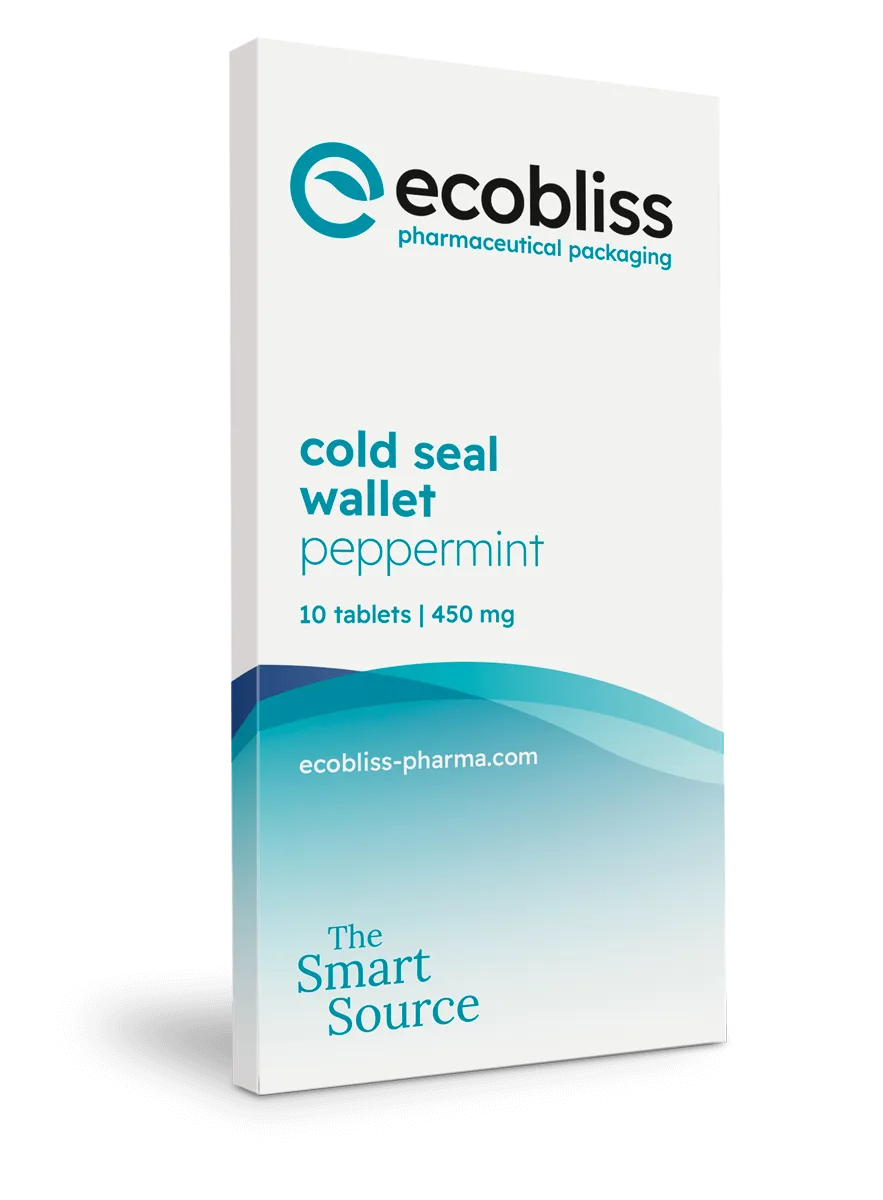
Tous les emballages en carton Ecobliss sont certifiés FSC (licence C194323). Les Cold Seal Wallets associent un carton recyclable à un blister intérieur, offrant ainsi la protection du plastique ou de l'aluminium et la recyclabilité du papier pour la partie visible.
Seringues préremplies et contenants spéciaux
Pour les injectables auto-administrés: seringues préremplies en verre ou en polymère. Le choix dépend du principe actif (certains ne tolèrent pas le silicone utilisé dans les seringues en verre), du patient (un enfant ou un adulte arthritique peut avoir besoin d’une seringue en polymère avec auto-injecteur) et du coût.
Pour les implants à libération de médicaments et autres dispositifs similaires, les polymères et céramiques biodégradables s'imposent progressivement. En 2026, la plupart de ces technologies restent au stade de la recherche, avec seulement quelques produits déjà homologués.
Comment choisir le bon matériau ?
D'après l'étude de stabilité, la démarche est descendante. Le principe actif détermine les exigences relatives à la barrière. Ces exigences définissent le matériau. Le matériau détermine le format (blister, flacon, vial, seringue). Le format détermine l'emballage secondaire.
Les entreprises perdent souvent du temps à procéder par rétro-ingénierie. Elles choisissent d'abord un format parce qu'il est esthétique, puis tentent d'adapter le matériau aux données de stabilité. Or, c'est rarement le cas. Si vous souhaitez un deuxième avis sur le choix d'un matériau, envoyez-nous les données de stabilité et les spécifications actuelles. Nous vous indiquerons si vous avez choisi le bon matériau ou si le lancement risque d'être catastrophique.
Demandez un échantillon gratuit maintenant !