

Pharmaceutical blister packaging


Walk into any pharmacy and most of what you see, beneath the cartons, is a blister of some kind. Tablet, capsule, sometimes a sachet. Each cavity sealed, each dose isolated. Easy to take for granted, until you start designing one for a tricky API or a complex dosing schedule. Then it gets specific fast, and that is exactly the work we take on as your single packaging partner, from design through to a finished, serialised pack.
What blister packaging actually does
A blister is unit-dose primary packaging. Each tablet or capsule lives in its own cavity, formed from plastic or aluminum, sealed with a foil or paper lidding. It protects the medicine from moisture, oxygen and contamination, gives the patient one dose at a time, and gives regulators a serializable surface they can track. That is the ideal version. The real version depends on the molecule, the patient and the market.
Designing for the patient, not the line
Adherence improves up to 30% when the blister layout matches how the patient actually takes the medicine. That changes what you put on the pack. Calendar layouts. Color-coded steps for titration regimens. Larger print where the prescription is for older patients. Child-resistance built in without making the pack impossible to open for someone with arthritis. We design for manufacturability from day one, so a layout that works for the patient also runs cleanly on the line, certified for EU and US markets through our Locked4Kids platform.
Why most of our customers run cold seal
Cold seal uses pressure to bond the blister between two paperboard layers, instead of heat. That matters in three ways: heat-sensitive APIs are not exposed to a sealing temperature, the line draws up to 80% less energy than heat seal, and the wallet ends up fully recyclable in a paper stream. Around 90% of our customers run cold seal as their default. We still run heat seal where the format calls for it, but cold seal is what we are known for, partly because we invented the technology.
Primary blister formats, when each one earns its keep
- PVC: cost-efficient, basic moisture barrier, fine for stable formulations.
- PVdC-coated: step up in moisture and oxygen barrier when stability data demands it.
- ACLAR: high moisture barrier, light-resistant, useful for sensitive APIs.
- Alu-Alu (cold-formed foil): the barrier ceiling, for hygroscopic and light-sensitive molecules.
Secondary formats around the blister
- Cold seal wallets: blister inside paperboard, easy-open, recyclable.
- Blister cards: paperboard backing with retail-friendly print area.
- Multi-panel wallets: complex regimens like titration packs.
- Folding cartons: kit-style clinical trial supplies.
Where it ends up
Specialty and prescription medicines for leading pharmaceutical companies, nutraceuticals, temperature-sensitive APIs in cold form foil with cold seal, and Phase I to III clinical trial packaging. This is where the value sits: complex, specialty packaging for high-value medication, the work few packaging partners can take on.
Sustainability, briefly
Up to 80% less energy than heat seal, recyclable paper-based wallets, water-based solvent-free adhesives, paperboard sourced FSC-certified (license C194323).
Got a blister project that needs designing properly?
Whether you are at clinical trial stage, scaling up to commercial, or working on a child-resistant specialty pack, send us the brief. Talk to our team, or grab a sample wallet.
Get a free cold seal wallet sample now!
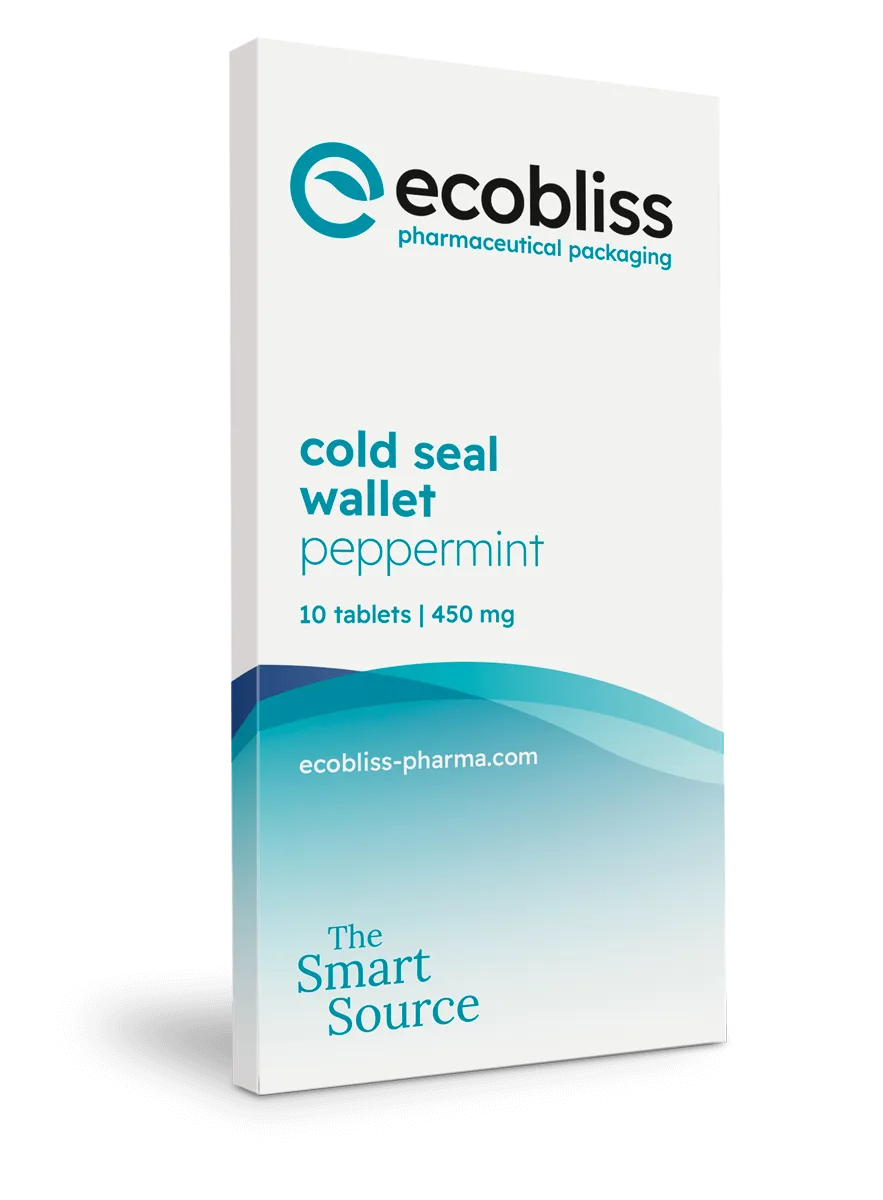
- See how the contents are perfectly sealed in the wallet
- Take a look at the excellent printing outside and inside
- Only high-quality carton is used. The sealing is eco-friendly!
Your sample request has been sent! You'll get a confirmation at the provided email address.


