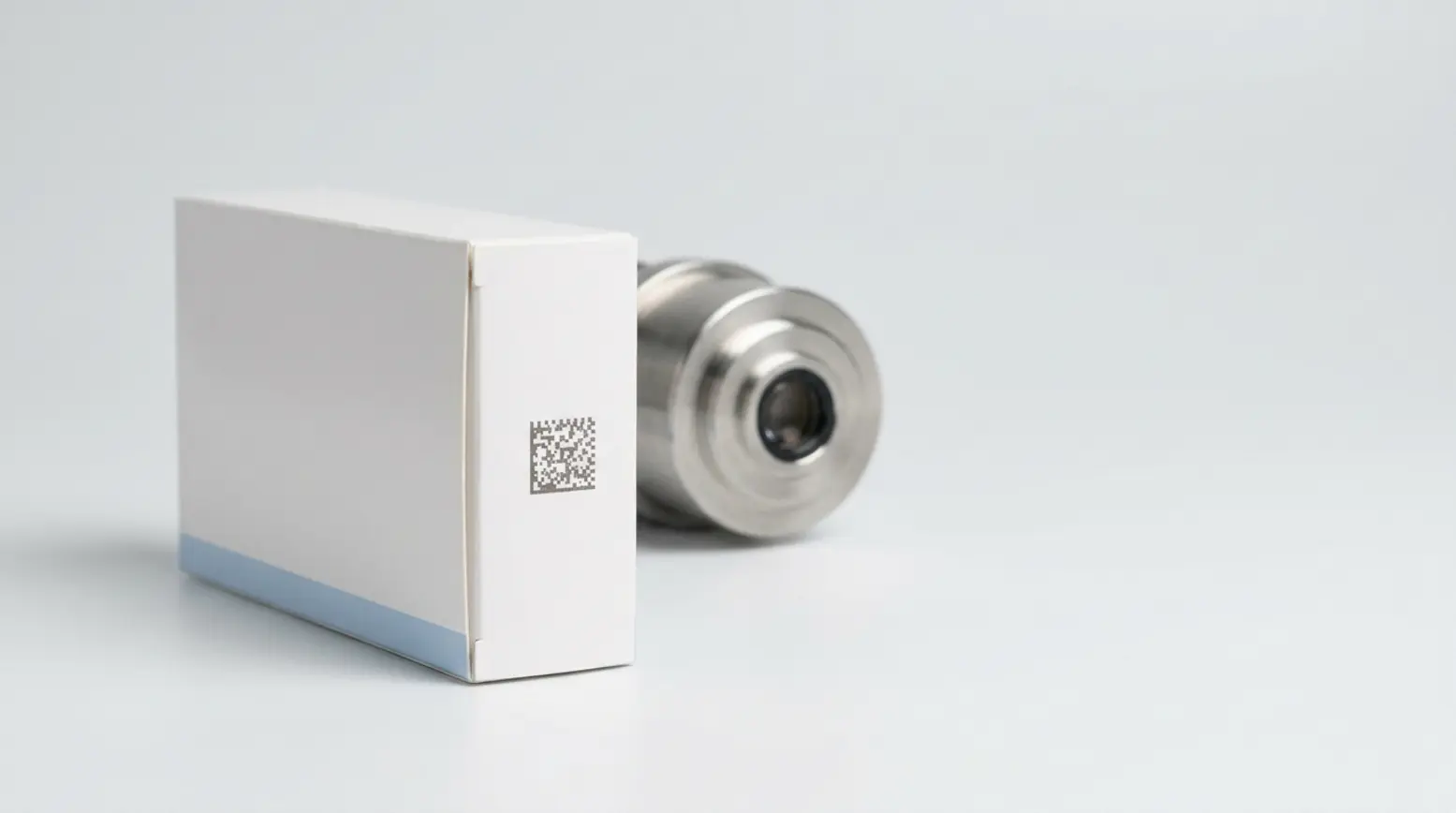

A data matrix code on medicine packs usually contains four main data items: a product code, a serial number, a batch number, and an expiry date. Together, these create a unique identifier on the medicine carton for a single saleable pack. Some markets may also require a national reimbursement number within the data matrix or another local identifier. This code is read during packaging, prior to distribution, and again at the pharmacy or another authorized dispensing point, ensuring the pack can be verified and its status updated correctly.
Ecobliss builds FMD-compliant serialisation into its pharmaceutical contract packaging, so packs leave verified and traceable.
• It typically contains a product code, serial number, batch number, and expiry date.
• These data items identify a single saleable pack.
• Some countries may require an additional local or national number.
• The code is scanned on the packaging line, before distribution, and at the point of dispensing.
• Carton layout, print contrast, surface quality, and code position all affect how easily the code can be read.
What a data matrix code on medicine packs usually contains
The data matrix code on medicine packs is a 2D code printed on the saleable outer carton of a pharmaceutical product. If someone asks what a medicine's data matrix code contains, the short answer typically includes four elements: a product code, a serial number, a batch number, and an expiry date. These are combined so that each pack can be identified as a distinct unit. Because every pack features its own serial number, the code facilitates pack-level verification throughout the supply chain.
Each component serves a clear purpose. The product code identifies the specific medicine and pack type. The serial number distinguishes one individual pack from all others of the same product. The batch number links the pack to its production batch for traceability. Finally, the expiry date indicates the medicine's shelf life. If any item is missing or incorrect, subsequent verification checks may fail; therefore, the encoded data and the human-readable text on the carton must perfectly align.
| Data element | Purpose | Standard checkpoint |
|---|---|---|
| Product code | Identifies the medicine and pack type | Packaging line, verification, dispensing |
| Serial number | Makes one pack unique | Packaging line, verification, dispensing |
| Batch number | Links the pack to production traceability | Packaging line and pack review |
| Expiry date | Shows the shelf life end date | Packaging line and dispensing review |
The four standard data elements
The product code identifies the medication and its presentation within the chosen coding system. The serial number uniquely identifies a single pack. The batch number connects that pack to a specific production run, while the expiry date indicates the end of its approved shelf life. Together, these elements ensure the code supports comprehensive traceability and unit-level verification.
When a national number is also needed
Certain countries may require an additional national or local identification number. This can include a reimbursement number or another market-specific code. Germany, Spain, and Portugal are frequently mentioned in discussions about local variations, but current national regulations should always be verified before artwork is approved. When teams search for "Data Matrix Code Arzneimittel," they are typically researching this medicine coding topic within a German context. Conversely, searches for "GS1 DataMatrix Pharma" usually relate to the standard coding format used for these data items in pharmaceutical packaging, even though specific national system details can still vary.
Why data matrix codes on medicine packs are used
A 2D data matrix on a medicine pack is used because it can store multiple data items within a very small area. In contrast, a linear barcode carries less data, making it less suitable when a pack requires product identification, serialization details, and traceability information all at once. Because medicine cartons offer limited surface space, a 2D format is typically the most practical choice.
These codes also facilitate machine reading throughout the packaging and supply processes. Cameras and scanners process the code much faster than manual checks, allowing packs to be seamlessly verified during production and, later, upon dispensing. This forms the foundation of pharmaceutical barcode verification. However, reliable scanning still depends on print quality, code contrast, and proper placement on the carton. A code that looks perfect in an artwork file might still fail on a physical carton if the surface texture, print setup, or positioning results in a poor image.
Where a data matrix code on medicine packs is scanned
The initial scan usually takes place on the packaging line. An inline camera verifies that the printed code matches the expected data for that specific pack and checks if it can be read efficiently at production speeds. If a code is unreadable or the data does not match, the pack is rejected and requires controlled status handling. This is critical because the physical pack and its serial data must remain securely linked, ensuring that any rejected unit is reconciled correctly.
Before distribution, the pack data is uploaded to the relevant verification system for the destination market. While the technical infrastructure behind this step can be complex, the core principle is simple: the data must be complete and accurate before the supply chain advances. Later, at the pharmacy or another authorized point of dispense, the code is scanned again. This is typically the decommissioning scan, where the unique identifier is verified and the pack's status is officially updated as it is supplied to the patient.
Additional scans may occur under specific circumstances. Wholesalers or healthcare institutions might scan packs to comply with local regulations or specialized internal workflows. In our experience providing secondary contract packaging with data matrix verification, we have learned that print control, inspection, reject handling, and reconciliation must work seamlessly together. Ultimately, successful scanning relies on the entire packaging process, rather than just the isolated code image.
Common scan points across the supply chain
The packaging line serves as the primary scan point, as the code must be validated against expected data at full production speed. Prior to distribution, this data must be securely logged in the required verification environment. At the pharmacy or another authorized dispensing location, the code is scanned to verify the pack and update its final status. In certain scenarios, wholesalers or healthcare providers may also perform scans if dictated by local rules or specific supply chain events.
How data matrix codes on medicine packs affect carton design and print setup
A data matrix code on medicine packs requires a clear, stable area on the carton. This space frequently competes with legal text, product information, Braille, tamper-evident features, local market requirements, and opening mechanisms. Given these space constraints, layout planning should begin early and be evaluated alongside medicine packaging readability. This proactive approach helps teams safeguard both machine readability and human legibility on the same pack.
Surface conditions are equally important. Codes should never be placed across folds, glue seams, rough textures, heavy varnishes, embossing, or any other features that could degrade image quality. The data matrix quiet zone must also be protected, as scanners require a clean, unprinted border around the symbol. Furthermore, carton contrast must be sufficient to support flawless reading under actual line conditions. Because cameras require a repeatable, consistent view, factors like code placement, pack movement, lighting, and print behavior are all critical variables during production.
Having perfect artwork is not enough. A flawless digital file does not guarantee a successful scan on the production line, as the camera view, printing process, substrate material, and carton handling can all alter the final result. We highly recommend reviewing these variables early on via design for manufacturability for serialized cartons. If delayed, initial tooling and layout decisions may severely limit your options later in the process.
How to plan for data matrix codes on medicine packs early in development
Early planning helps secure the designated coding area long before tooling is finalized. This is especially vital when a carton features multiple languages, extensive legal content, child-resistant mechanisms, or an unconventional structure. By designing packaging with manufacturability, component production, and packing steps in mind, teams can evaluate coding, layout, and handling as a single, cohesive system. This holistic approach ensures that potential issues are identified early, when modifications are still relatively easy and inexpensive to implement.
Complex packs demand even earlier coordination, as spatial conflicts emerge much faster. A prime example is the 168-tablet multi-strength packaging case, where information density is extremely high and strategic layout choices are paramount. When a package carries a large amount of content, camera access and code protection must be planned from the very beginning. This mitigates the risk of late-stage artwork revisions that might inadvertently force the code into an unreadable location.
What a data matrix code on medicine packs does not mean for Blisterserialisierung
Under European safety feature regulations, the unique identifier is strictly designated for the saleable outer pack. This means that saleable pack serialization applies exclusively to the carton supplied to the patient. It does not imply that every blister cavity or individual blister strip must carry its own serialization code. For this reason, the concept of Blisterserialisierung (blister serialization) should be carefully clarified during project scoping.
While certain customer workflows or specific markets may request additional coding directly on the blister material, this is a separate requirement and should never be assumed as the standard rule. Therefore, teams must first determine the official saleable unit, and only then verify which coding requirements apply to that specific unit within the target market.
Practical checklist for reviewing a serialized medicine pack
Before final approval, you should review the entire coding setup as one interconnected process. Thoroughly check the data content, destination market requirements, designated code area on the carton, print and surface conditions, inline verification plans, reject handling protocols, reconciliation procedures, and the anticipated dispensing scan workflow. Since a minor oversight in one step can snowball into a major issue later, reviewing the full journey from printing to final dispensing is highly beneficial.
It also helps to ask practical questions during this review process. Is the code positioned on a flat, highly visible area? Is the quiet zone fully protected? Can the camera read the code clearly at full line speeds? Are Braille, varnishes, folds, glue seams, or tamper-evident features too close to the symbol? Have the most current local requirements been verified for each target market? If you have a live project that needs reviewing, you can discuss your data matrix packaging setup with us. Bring your artwork, target market list, pack format, and expected batch information to ensure the consultation remains practical, specific, and actionable.
FAQ on medicine pack data matrix codes
What is in the data matrix code on a medicine pack?
In most cases, it includes the product code, serial number, batch number, and expiry date. Together, these elements uniquely identify a single saleable pack. However, some regional markets may also require an additional national or local identifier.
Who reads the code first?
The initial read typically occurs on the packaging line. An inline camera verifies that the printed code matches the expected data and ensures it can be reliably scanned under actual production conditions.
Why is a 2D code used instead of a linear barcode?
A 2D code can condense multiple data elements into a very small area. This makes it highly advantageous for medicine cartons, which require product identification, serialization data, and traceability information all on a single pack.
Is the unique identifier usually on the blister?
No, the unique identifier is typically located on the saleable outer carton. While additional coding directly on the blister may be requested for specific projects or regional markets, this is considered a completely separate requirement.
Why is code placement important?
Placement directly dictates whether cameras and scanners can read the code reliably. Folds, glue seams, heavy varnishes, poor print contrast, nearby Braille, and rough surface textures can all significantly diminish scan quality.
Can wholesalers or hospitals also scan the code?
Yes, they can do so in defined situations. The exact circumstances depend on local regulations and specific supply chain workflows, meaning teams should always confirm which rules apply within their intended target market.
Request a free sample now!