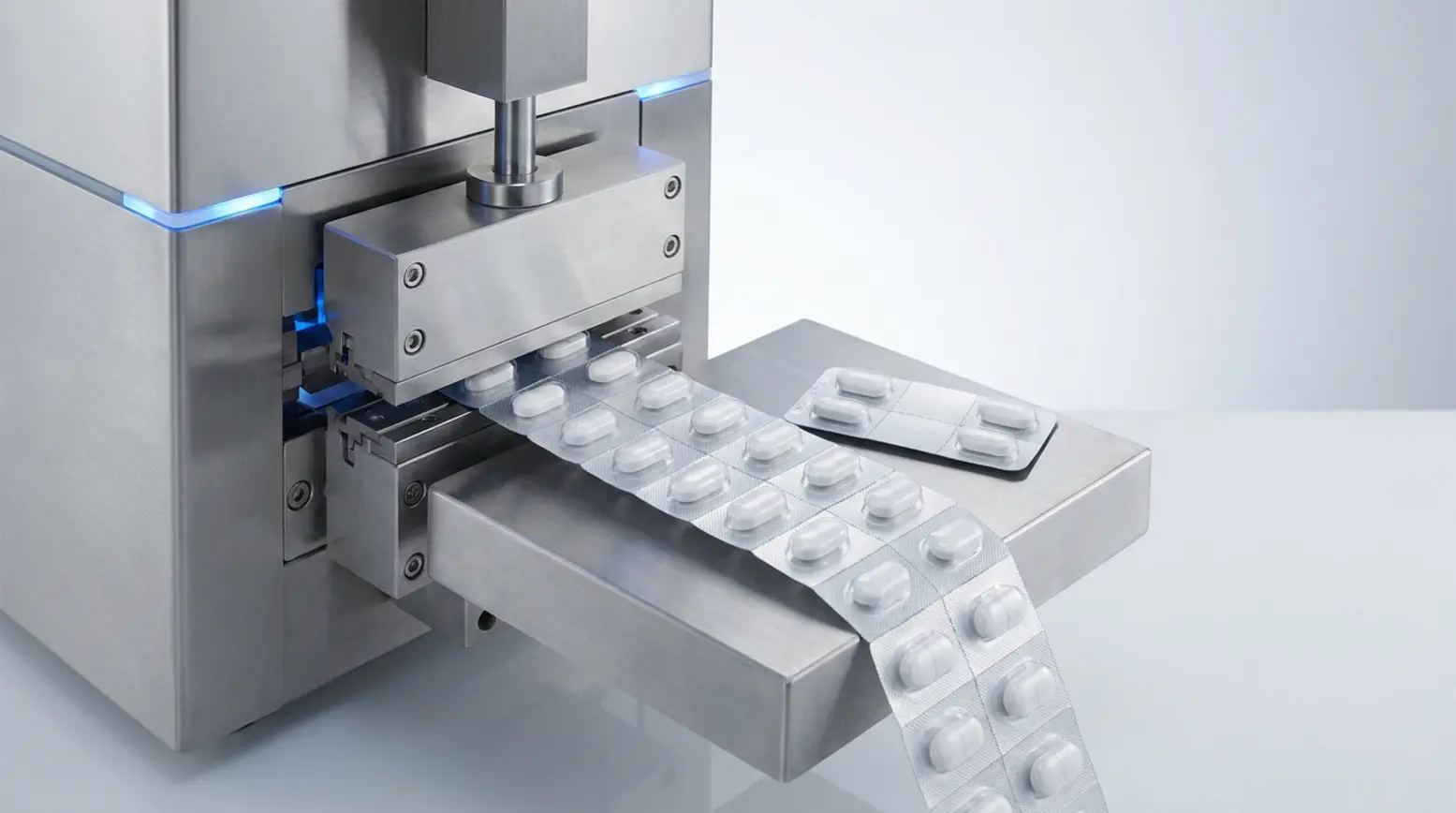

Design for manufacturability in packaging means designing the pack and the production method together from the start so that the concept can be manufactured repeatedly within agreed limits. In pharmaceutical packaging, this matters because a pack might look correct in a drawing or hand sample, yet still fail when run on actual equipment. The primary question is simple: will this packaging design run on the line with stable quality, suitable materials, and realistic tolerances? This article explains what to review early, how blister forming and sealing reliability are affected, and what a packaging line trial can truly prove before a design freeze.
• Design for manufacturability in packaging verifies whether a concept can be produced repeatedly with consistent quality on the intended line.
• Small design choices can significantly affect feeding, forming, sealing, cutting, coding, inspection, and product protection.
• Production-intent materials and packaging tolerances must be integrated into the design phase, as late changes can introduce new risks.
• A hand sample facilitates early discussion, but a packaging line trial is necessary to assess true runnability under production-relevant conditions.
• A thorough manufacturability review should clearly define dimensions, tolerances, materials, process assumptions, and acceptance criteria.
Design for manufacturability in packaging starts with the production method
Design for manufacturability in packaging means that the pack concept and the production route are developed together. This serves as a practical safeguard, as the team needs to ensure the concept can be manufactured repeatedly within agreed limits. In general industry practice, this includes dimensions, seal quality, print position, coding, inspection results, and overall pack appearance when relevant. While visual approval supports the concept phase, it does not confirm a producible pack design.
What design for manufacturability means in practice
In practice, DFM packaging design is fundamentally about repeatability. A pack must behave consistently across normal process variations, meaning a single successful sample is never enough. Teams must ask whether the geometry, materials, tooling, and equipment will function harmoniously on the intended production route. This is why a manufacturability review focuses on production reality rather than visual intent alone.
A good concept is not always a producible pack design
A hand sample is useful because it helps teams evaluate shape, product fit, opening logic, and initial visual ideas. However, it cannot test line speeds, repeated cycles, or how the complete process behaves over time. Therefore, a concept can meet the visual brief yet still require modifications before becoming a packaging design that runs successfully on the line.
Why design for manufacturability in packaging matters in pharma packaging design
In pharma packaging design, early choices impact far more than appearance. They influence product protection, line reliability, coding space, inspection performance, and overall pack consistency. This reflects general industry context, and it is crucial because even a minor dimensional change can disrupt subsequent steps on the line. If these factors are overlooked early on, teams frequently face additional sampling, costly tooling changes, or project delays.
Why patient needs still matter
Manufacturability must ultimately support patient use, as the pack still needs to be intuitive and practical in real life. While this article focuses strictly on production feasibility, you can explore broader contexts in our pharmaceutical packaging design guidelines and our insights on user-centric pharmaceutical packaging design, which detail wider design and usability considerations.
Small design changes can create large production effects
A slight increase in blister pocket depth can compromise forming stability. A tighter corner radius alters how the material stretches, potentially causing the pocket wall to become too thin in critical areas. Furthermore, a minor shift in allowed size can affect the feeding position, cutting quality, or seal area. Consequently, tooling risks in packaging should be reviewed early; a small change on paper can yield a massive impact during production.
Design for manufacturability in packaging and blister forming reliability
Blister forming reliability depends on interconnected design inputs. These include pocket geometry, draw depth, corner shape, product dimensions, and material response. During design for manufacturability in packaging, these factors should be treated as early technical inputs, since forming risks originate at the concept stage and can remain hidden until actual line work begins.
Pocket geometry and draw depth
Deep pockets demand more from the forming process. If the draw depth is too high for the chosen material and shape, the wall thickness can become uneven, reducing pocket strength. This is critical because the blister must protect the product and retain its shape through sealing, cutting, transport, and subsequent handling.
Corner radii, product dimensions, and material response
Tight corners create greater stress during the forming process. Product size and shape are equally important; a sharp tablet edge, a wide capsule, or a high fill level can all alter the necessary pocket design. Geometry and material behaviour interact closely, meaning a design that looks acceptable in a sketch might behave entirely differently when formed on equipment.
Why production-intent materials matter
Production-intent materials are essential because final commercial materials often behave differently from easy-to-form sample materials. Stiffness, memory, barrier structure, and forming characteristics can all significantly change the outcome. For this reason, blister forming reliability must be verified using materials that match the intended production route as closely as possible.
Design for manufacturability in packaging and blister sealing reliability
Blister sealing reliability is a core component of both pack performance and line stability. Effective sealing depends on the correct material fit, sufficient seal area, suitable surface conditions, and a workable process range. A pack that seals perfectly once during sampling can still struggle during repeated production if these variables are not evaluated early.
Material compatibility and seal area
The forming web and lidding material must be compatible with the sealing method used on the production line. Additionally, the design requires ample seal area around the pocket and other critical zones. If the seal area becomes too narrow due to pack shape, graphic elements, or layout decisions, the sealing process can become unstable.
Surface condition and process window
Seal quality depends on much more than simply the material named in a specification. Surface condition, flatness, coating behaviour, and the available operating range for heat and pressure all influence the final result. A narrow process window means that even slight variations can lead to unstable outcomes; therefore, the design should accommodate a broader sealing range wherever possible.
What weak sealing can affect
Weak or uneven sealing compromises pack integrity and product protection. It can also negatively impact coding positions, inspection results, pack shape, and overall reject rates. For these reasons, blister sealing reliability should be thoroughly reviewed as part of the initial concept, rather than being treated as an afterthought in production.
Design for manufacturability in packaging depends on tolerances, materials, and review timing
Nominal dimensions are merely a starting point. In actual production, packaging tolerances accumulate across various components and process steps, meaning the final outcome relies on the entire manufacturing chain. Material behaviour must also be evaluated during the design phase, as a late material change can drastically alter forming, sealing, folding, print response, and overall repeatability.
Why packaging tolerances accumulate
Every operation introduces some degree of variation. Forming, sealing, cutting, folding, and assembly all operate within their own specific limits. While a single minor shift might be acceptable in isolation, several combined shifts can easily push the pack outside its target range. This is why teams must review tolerance stack-up early when assessing line fit and tooling risks in packaging.
Material behaviour as a design input
Material selection significantly affects stiffness, memory, fold behaviour, barrier requirements, print response, and sealing behaviour. These factors serve as core design inputs because they influence both the function of the pack and the performance of the line. If material selection is treated merely as a late-stage purchasing step, the approved concept may behave entirely differently once actual production begins.
Start the manufacturability review before the design is locked
The manufacturability review should begin long before the visual design is locked. Useful early inputs include product data, line limits, target output, pack counts, market needs, and key quality requirements. When we support design for manufacturability, we utilize this stage to shorten the feedback loop among concepts, component choices, and production intent, allowing potential issues to be identified much earlier.
What the manufacturability review should deliver
A comprehensive review should define agreed-upon dimensions, tolerances, materials, process assumptions, and acceptance criteria. This approach ensures that the entire team shares a clear vision of what the pack must achieve and how it should perform on the line. While this review fosters better decision-making before tooling and line work commence, it does not replace formal qualification, validation, or customer approval. As a manufacturable concept advances toward execution, pharmaceutical contract packaging can facilitate the next production steps; however, the packaging process itself does not substitute for dedicated trials or formal approval procedures.
What a packaging line trial really shows
A packaging line trial tests the pack under production-relevant conditions. It reveals exactly how the product, components, tooling, and equipment interact along the intended route. This is critical because design for manufacturability in packaging is proven by repeatable performance, rather than by a single, attractive sample. The ultimate question is whether the pack can run continuously, yielding stable output and acceptable variation.
What to test during a line trial
A valuable packaging line trial will evaluate feeding, registration, forming, sealing, cutting, folding, coding, inspection, and reject handling, where applicable. The exact scope depends largely on the pack format and the specific line setup. The primary goal is to observe stability across the entire process, as success in one isolated step does not guarantee that the overall production route is ready.
Why a hand sample cannot prove runnability
A hand sample simply cannot replicate line-speed behaviour, the effects of repeated cycles, or the complete interaction among tooling, materials, the product, and the equipment. While it serves to support early concept discussions, it fundamentally cannot prove runnability. Recognizing this limitation is crucial when teams compare a mere concept sample against the rigorous demands of an actual packaging line trial.
Questions to ask before design freeze
Before implementing a design freeze, it is essential to ask clear questions: Are the dimensions and packaging tolerances realistic? Are the chosen materials true production-intent materials? Has the team thoroughly reviewed the main process risks associated with the intended equipment? Finally, is there sufficient evidence that this is a genuinely producible pack design? If you want an early assessment of your project's production readiness, you can start a packaging quickscan to share your current concept and primary concerns.
FAQ about manufacturability in pharmaceutical packaging
What is the difference between design approval and manufacturability approval?
Design approval indicates that a concept meets the initial brief and intended use. Manufacturability approval, on the other hand, confirms that the concept is practical for repeated production within agreed-upon limits. A pack can easily pass the first step yet still require substantial modifications before it is ready for the production line.
When should a manufacturability review begin?
It should begin well before the visual design is finalized. An early review helps teams align geometry, materials, process assumptions, and tolerances before making changes becomes significantly more difficult and expensive.
Can a line trial replace qualification?
No. A developmental line trial helps the team understand how the design behaves under production-relevant conditions. Qualification is a distinct, formal activity with its own specific purposes and rigorous requirements, meaning the two processes serve entirely different functions.
Why do production-intent materials matter so much?
They matter deeply because actual material behaviour dictates forming, sealing, folding, printing, and overall repeatability. Relying on a sample made from an alternative material can generate a false sense of confidence; therefore, testing must match the intended commercial route as closely as possible.
Request a free sample now!