
The right blister lid depends on three things: who opens the pack, how fragile the product is, and what level of safety the packaging must support. In most cases, a push-through format works well for robust tablets and users with adequate hand strength. A peelable lid is often better when users have weaker hands or when the dose could break under pressure. Peel-push formats add a two-step opening sequence, allowing for a more controlled access concept. Ultimately, the final choice should always be evaluated within the complete pack, because lidding foil for blisters affects opening ease, seal performance, and product protection all at once.
• Start with the user, as finger strength, grip, vision, and dexterity dictate the most suitable opening method.
• Check the product next. Fragile tablets may crack in foil blister packs that require a high push force.
• Use push-through blister foil for familiar, fast access when both the user and the dose can handle the pressure.
• Use peelable lidding foil when access is more challenging or the dose should not be forced through the lid.
• Prove the final choice through prototypes and full-pack testing, as material data alone is never enough.
What lidding foil for blisters does in a pharma pack
Lidding foil is the layer sealed over formed blister cavities. It dictates how a patient accesses their dose while simultaneously supporting the barrier and seal performance of the package. Because of this, lidding foil for blisters should never be selected based on a data sheet alone. The lid must work in harmony with the cavity, seal area, tab, print, and the outer wallet or carton. While product managers typically prioritize patient use and safety, packaging engineers tend to focus on seal strength, opening force, and machine compatibility. Both perspectives are valid, meaning the best decisions bring these teams together early in the process.
When searching for lidding foil for blister formats, most teams want a practical answer. They need to know which lid family best fits the user, the medicine, and the safety targets. That answer can only come from a full-pack perspective. A lid that looks perfect on paper might still fail in real-world use if the tab is too small, the text is difficult to read, or the required opening force does not match the actual user's capabilities.
How to compare lidding foil for blisters by patient need
Start by evaluating the intended user. Consider their finger strength, how well they can grip the blister, their level of dexterity, and whether they can easily follow a one-step or multi-step opening sequence. Vision also matters, as patients need to clearly see where to begin and what to do next. If the packaging is intended for older adults or individuals with reduced hand function, these questions become even more critical. For additional context, our guide on senior-friendly medicine packaging explains why access requires careful design and realistic testing.
Next, factor in the product and its specific safety requirements. A robust tablet often works perfectly in a push-through format, but a brittle dose may chip or crack if the required push force is too high. If child resistance is necessary, a simple opening method will not suffice. For complex therapies, the outer packaging can also help guide the dosing order, especially in wallets or titration packs. Therefore, lidding foil for blisters should support both safe access and clear usability over time.
When lidding foil for blisters should be push-through
What push-through means
A push-through format requires the patient to press the medicine directly through the lid. This design typically uses hard-temper aluminium foil that ruptures when enough pressure is applied. As one of the most familiar opening methods in the pharmaceutical industry, most users understand it without needing extensive instructions.
Where push-through works well
Push-through blister foil is highly effective when users have adequate hand strength and control. It provides direct access to the medication and is very easy to explain. For many standard tablets, this method supports a straightforward daily routine. It also suits packaging where speed and familiarity take precedence over a multi-step opening sequence.
Limits of push-through
Push-through packaging is not automatically child-resistant. Relying on a higher push force alone does not guarantee child-resistant blister foil performance. Package geometry, cavity layout, and the overall opening system play significant roles. Product fragility can also influence this decision. Even if the user can comfortably manage the push force, the dose itself might not survive it. A larger, uniquely shaped, or brittle tablet can easily break during removal. For this reason, development teams should always test the actual product in the final cavity before locking in their foil choice.
When lidding foil for blisters should be peelable
What peelable lidding means
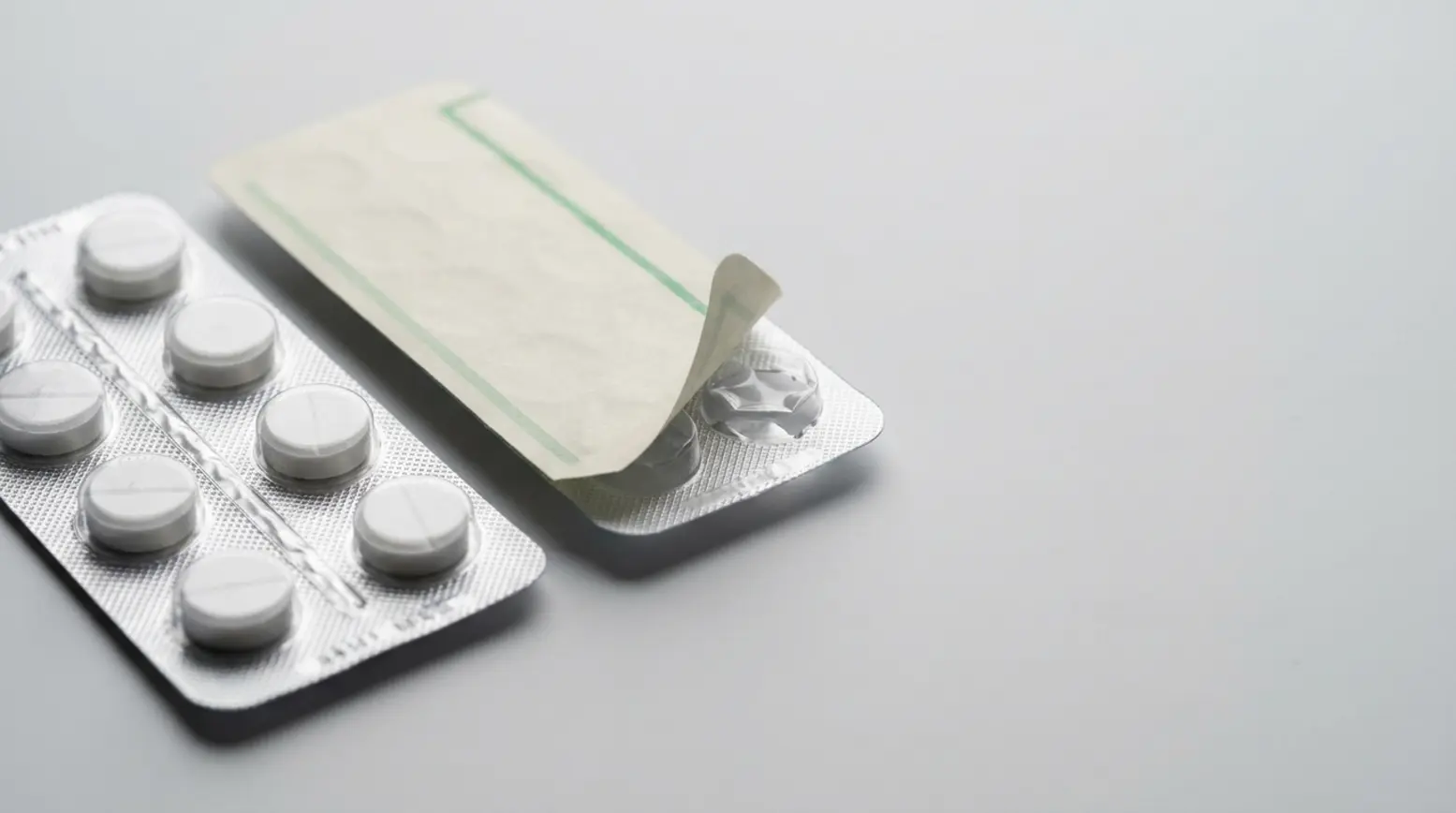
Peelable lidding foil is completely removed before the patient extracts the dose. Common industry terms for this format include paper-backed lidding and PET-backed blister lid structures. In both scenarios, the user lifts a corner tab and peels away the top layer instead of pushing the product through the foil.
Where peel formats help
A peelable format can be a superior option for users with weak hands, lower grip strength, or limited push control. It also helps protect fragile products, as the patient does not need to force the medication through a rigid foil layer. Consequently, peelable lidding foil frequently suits a senior-friendly blister concept or any product that is susceptible to damage during opening.
What must be tested
Peelable formats still require careful validation. Teams should test the blister peel force, tab size, tab location, peel path, and seal consistency with the intended user demographic. Printed instructions must be perfectly clear, and color contrast should be strong enough to clearly indicate where the opening process begins. By addressing these factors, the lid becomes much easier to understand and operate. We design these types of structures as an integral part of the full package, because small details can dramatically alter real-world usability.
When lidding foil for blisters should be peel-push
What peel-push means
A peel-push blister utilizes a two-step action. First, the patient peels away an outer layer. Then, they push the dose through the remaining foil layer. This creates a significantly more controlled opening path than a standard push-through format.
Why peel-push is used
Peel-push formats are generally used when a package requires greater opening control. Because the user must complete more than one coordinated action, this format easily supports comprehensive child-resistant concepts. However, the lid still functions as just one part of a full system. For more details on striking the right balance between safety and accessibility, explore our insights on child-resistant, senior-friendly packaging.
Why full-pack testing matters
Child resistance and senior friendliness can often pull in opposite directions. A package that is difficult for a child to open might also pose a challenge for an adult with limited hand strength. Because of this dynamic, the ideal balance must be proven through rigorous testing of the complete package. A peel-push blister material chart simply cannot demonstrate real-world pack performance on its own.
How the rest of the pack changes the lidding choice
Seal strength, print, tabs, and cavity layout work together
The lid does not function in isolation. Seal strength, peel force, push force, cavity depth, cavity shape, and tab design all influence the final opening experience. Print quality matters just as much, since clear words and symbols actively help reduce user errors. This is especially vital when a patient must follow a specific sequence or when the opening point is quite small. Good design fundamentally improves comprehension, thereby supporting both usability and safety.
The carton or wallet can guide the opening sequence
For specialty medications, the outer format often guides how the blister is used. A wallet layout can support a day-by-day progression, while a carton can subtly influence how the patient handles the blister before ever attempting to open it. As a result, the foil choice should perfectly match the entire user journey, from the first touch down to the final dose removal.
Why prototypes with intended users are essential
Early prototypes help development teams identify problems long before tooling and scale-up occur. They reveal whether the chosen lid, cavity, tab, and graphics truly work together in real hands. Our approach to human factors and manufacturability strictly follows this full-pack methodology, ensuring that opening performance and production realities align perfectly from the very start.
Testing and proof for child resistance and adult usability
What can be proven only at the full-pack level
True child-resistant and senior-friendly performance can only be validated at the complete pack level. The same principle applies to verifying the opening sequence and observing real-world user behavior. While a specific lid structure can support your overall goal, it cannot guarantee the final result on its own. Ultimately, the complete design, the actual product, and the intended users will determine whether the package works exactly as planned.
Validated capability example
We proudly point to our certified capability regarding ISO/EN 8317 and F=1 under US 16 CFR 1700.20 as proof of our extensive experience. These references matter because they demonstrate thoroughly tested capabilities, though they cannot predict the success of a future package in isolation. For a published example of our complete pack engineering, explore this 168-tablet child-resistant pack case, which seamlessly combines five medication strengths and controlled access into a single, cohesive solution.
A practical rule for selecting the right lidding family
A simple rule can help keep early decisions strictly on track. First, clearly define the user. Next, define the safety requirements. Then, build a functional prototype of the opening mechanism. Finally, test the full pack with its intended users. Following this structured approach helps teams avoid choosing lidding foil for blisters from a narrow material list without properly evaluating real-world use, product fragility, and the broader packaging design.
If you are comparing opening behaviors during the development phase, a hands-on review is often the fastest way to learn what truly works. You can request a child-resistant sample to physically evaluate the access, opening sequence, and overall handling in a realistic package format.
Common questions about blister lidding choices
What is the difference between push-through blister foil and peelable lidding foil?
Push-through blister foil ruptures when the patient physically presses the dose through it. Conversely, peelable lidding foil is entirely removed before the dose is extracted. Push-through formats are often faster and more familiar to the average consumer. On the other hand, peelable options can be much easier for individuals with weak hands and typically offer better protection for highly fragile doses.
Is peel-push always the best choice for child-resistant packaging?
No. While a peel-push format can strongly support a child-resistant concept by requiring a two-step action, the complete package must still undergo rigorous testing. Material choice alone does not legally or practically prove child resistance or general adult usability.
Can a fragile tablet still use push-through foil?
Sometimes it can, though the final answer heavily depends on both the product formulation and the cavity design. If the required push force is too high, the tablet may easily crack or chip. Therefore, engineering teams should always test the actual dose within the intended blister before committing to a specific format.
How do you evaluate blister peel force?
You should evaluate blister peel force using a combination of technical measurements and direct user testing. The required force must be consistent, but the package must also remain easy to start, hold, and understand. Elements like tab design, the seal area, and printed graphics will all directly affect the end result.
What makes a pack senior-friendly?
A senior-friendly package is highly manageable for adults who may have reduced physical strength, less fine motor control, or weaker eyesight. Features like clear instructions, highly visible tabs, excellent color contrast, and a realistic opening force all contribute to success. However, the strongest proof of efficacy still comes from practical testing with the exact demographic that will ultimately use the package.
Request a free sample now!