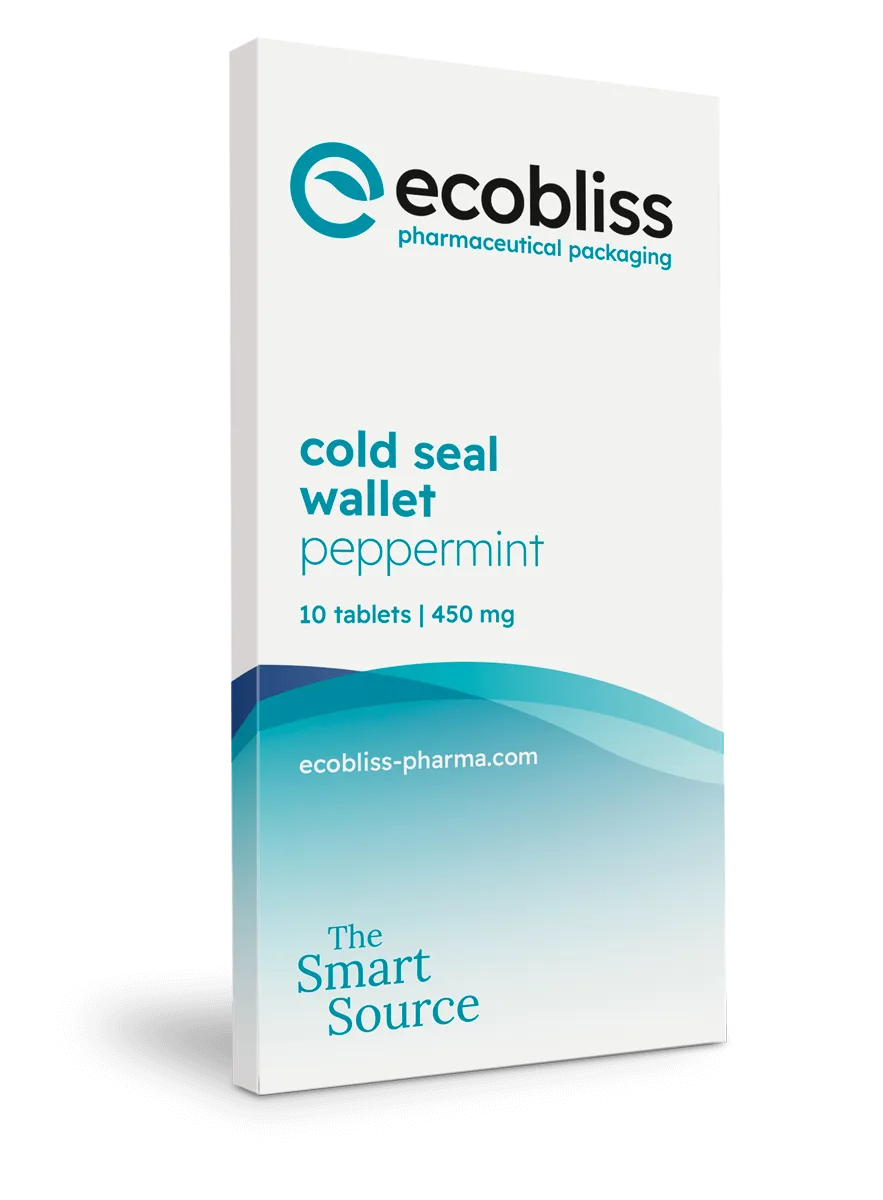
Cold sealing is one of those technologies that sounded experimental in the 1990s and is now the default for most premium pharma blister packaging in Europe. The reason isn't marketing. It's that once you do the engineering math on heat seal vs cold seal lines, the trade-offs go one way.
How cold seal works
A water-based adhesive is applied to two paperboard layers during the wallet manufacturing process. When the layers come together with a blister sandwiched between them, mechanical pressure activates the adhesive and creates a permanent bond. No heat, no temperature, no warm-up.
That's the whole story. The complexity is in the adhesive chemistry, not the process. Cold seal adhesives have to bond reliably under pressure, stay inert at room temperature for the full shelf life, and not migrate into the API even after years on a shelf. We've been refining ours since the 1990s.
What changes when you remove the heat
Three things, mostly:
Energy. Heat seal lines run constant warm-up cycles. The energy bill on a heat seal facility is roughly five times what a cold seal facility burns for the same throughput. That's a 80% reduction, not a marketing number.
API protection. Heat seal exposes the product to elevated temperature during sealing, briefly. For most stable APIs that's fine. For biologics, hormone therapies, and certain heat-sensitive specialty drugs, it's a stability risk you'd rather avoid.
Line behavior. Cold seal starts up faster (no warm-up), changes formats faster (no cooling), and produces less waste during stoppages. Operators love it because the line is more predictable.
Where cold seal is the wrong choice
Two cases. First, traditional thermoform-foil blisters where the foil itself is heat-bonded to the plastic cavity. That format requires heat. We run heat seal lines for those products too.
Second, very high-volume OTC where the cost-per-unit advantage of high-speed heat seal lines outweighs the energy savings. For mass-market vitamins and OTC pain medication, heat seal still wins.
For everything else, cold seal wins. That's why 90% of our pharma customers default to it.
The recyclability angle
Cold seal wallets pair FSC-certified paperboard with the blister inside. Because the bonding adhesive is water-based and solvent-free, the paperboard layer can be separated and recycled at end-of-life. That makes cold seal one of the few pharma packaging formats that actually delivers on the sustainability story instead of greenwashing it.
For pharma companies under ESG reporting pressure, that's increasingly relevant. The carbon footprint per pack is publishable, the recyclability is real, and the cold seal step itself runs on a fraction of the energy of heat seal.
Where cold seal goes from here
The technology is mature in 2026. The interesting innovation is in pack format: titration regimens with color-coded steps across 168 cavities, child-resistant Locked4Kids variants for schedule-controlled drugs, multi-language wallets for international launches. The cold seal step itself is the boring foundation.
If you're spec'ing a new pack and curious whether cold seal is the right call for your API, tell us about the product. The answer depends on your stability data, your patient profile, your launch geography, and your sustainability targets. We'll work through it with you in a single conversation.
Request a free sample now!