
When a medicine is in scope, packaging under the Falsified Medicines Directive means the outer carton must carry two safety features: a unique identifier and an anti-tampering device. One is a code that is scanned and checked against stored data, while the other is a physical sign showing whether the pack may have been opened. This requirement affects artwork, carton layout, tamper-evident design, line setup, and pre-production checks. For broader context, you can read our article on anti-counterfeit packaging for medicines before returning to the specific pack changes explained here.
Ecobliss builds FMD-compliant serialisation into its pharmaceutical contract packaging, so packs leave verified and traceable.
• A carton in scope needs both safety features, so the pack design must support digital checks and physical inspection.
• Scope usually starts with Annex I and Annex II of the FMD, but your regulatory team must confirm the status of your specific product.
• The code needs a stable location on the carton because folds, glue areas, abrasion, and seal placement can reduce readability.
• The carton design of the anti-tampering device can affect opening, transport, line cameras, and reject handling.
• Early agreement across artwork, engineering, operations, and packaging partners helps avoid delays before the first batch is produced.
What readers need to know first about Falsified Medicines Directive packaging
The initial questions are direct: what does the carton need, is the medicine in scope, and what must change on the pack? For products in scope, Falsified Medicines Directive packaging requires two separate safety features on the outer carton. These are the unique identifier and the anti-tampering device. In simple terms, one supports EU FMD serialisation by being scanned and checked against stored system data, and the other supports visual inspection by showing possible opening.
This matters early in a project because the two features affect different parts of the pack. The unique identifier requires dedicated space on the outer carton, high contrast, and clear camera access. Meanwhile, the anti-tampering device needs a physical location and a design that remains functional after packing and handling. As a result, FMD requirements for packaging quickly shift from regulatory compliance to artwork, engineering, and line planning.
How Falsified Medicines Directive packaging defines scope through Annex I and Annex II
Prescription medicines and Annex I
Prescription medicines are generally in scope unless they are listed in Annex I. This gives teams a practical starting point, helping them narrow their initial review to the correct products. It also keeps project discussions focused before any packaging changes are approved.
Non-prescription medicines and Annex II
Some non-prescription medicines are also in scope if they are listed in Annex II. Therefore, over-the-counter status alone does not answer the question. A non-prescription product may still require the same safety features on its medicine packaging if it appears in Annex II.
What you should do next
This article does not interpret the annex lists for any specific medicine. Scope and approval decisions strictly remain with the product owner and regulatory team. Therefore, you must confirm your product's status internally before freezing artwork, ordering components, or validating a line. This is the safest way to handle Falsified Medicines Directive packaging without overstepping legal boundaries.
The two safety features in Falsified Medicines Directive packaging and how they work on the pack
The unique identifier
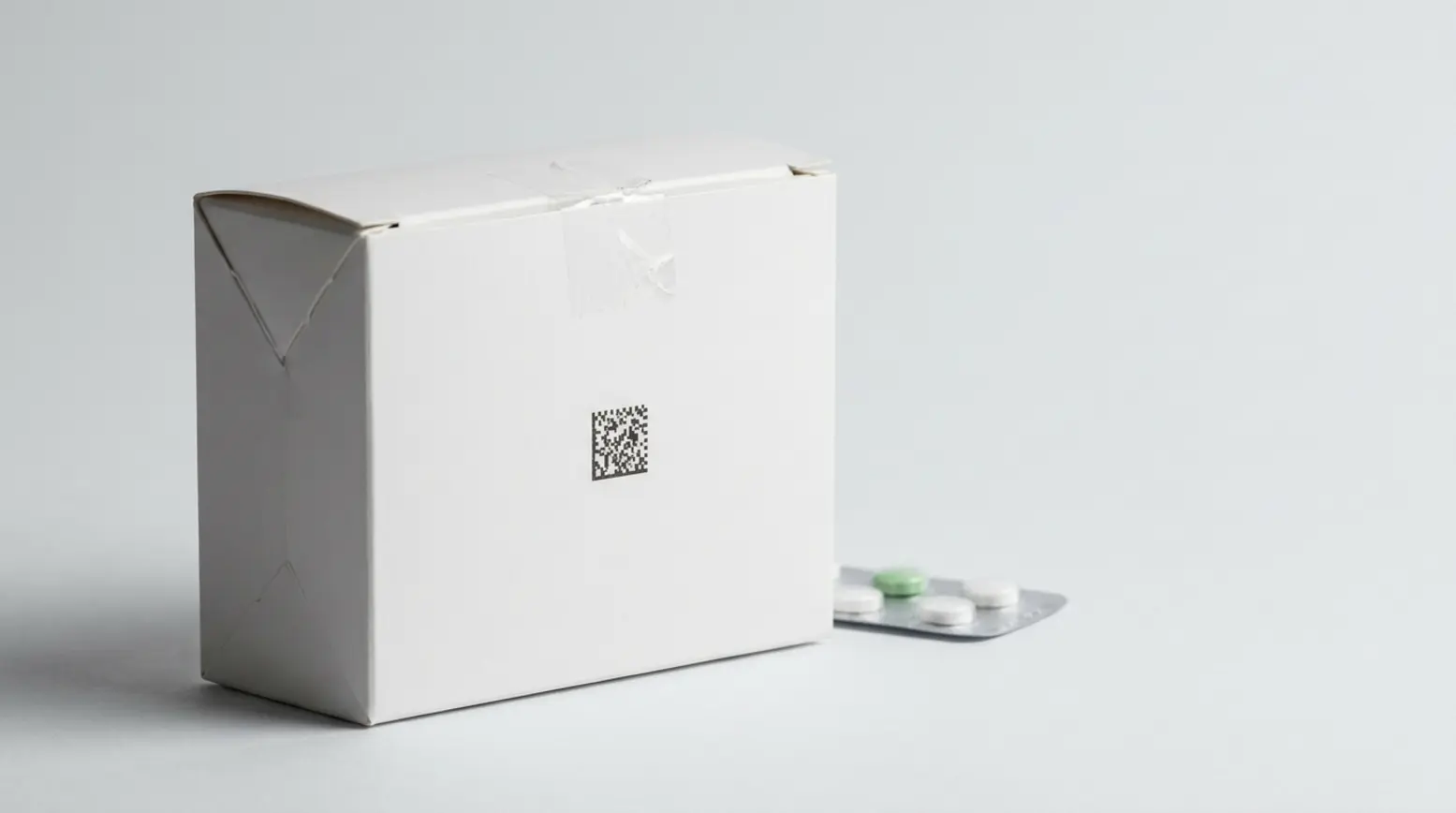
The unique identifier usually includes the product code, serial number, batch number, and expiry date. In some markets, a national reimbursement or identification number may also be required. On the pack, this is often carried in a 2D data matrix and linked to stored data. Because of this, proper placement of the data matrix on the carton is a practical packaging issue, not just a data management one.
The anti-tampering device
The anti-tampering device is a physical sign on the pack that helps the person supplying the medicine see whether the carton may have been opened. This feature may be built directly into the carton design, or it may utilize a tamper-evident seal label. The chosen format must remain functional during production, transport, storage, and normal handling.
Keep the two functions separate
Teams often make faster decisions when they separate these two functions clearly. The unique identifier is scanned and verified, whereas the anti-tampering device is checked by visually inspecting the physical pack. In this way, packaging for the Falsified Medicines Directive becomes easier to manage because each feature has its own technical requirements, even though both must function together on a single carton.
• Feature: Unique identifier. What it does: identifies an individual pack with coded data. How it is checked: scanned against stored system data. What it changes on the pack: code area, print contrast, placement, and camera access.
• Feature: Anti-tampering device. What it does: shows possible opening. How it is checked: visual inspection of the physical pack. What it changes on the pack: carton construction, opening path, seal position, and transport performance.
What Falsified Medicines Directive packaging changes in artwork and carton layout
Data matrix carton placement
The code needs a stable and usable location on the outer carton. Good data matrix carton placement avoids glue flaps, folds, seal labels, and surfaces that may rub during handling. If the code is positioned poorly, readability can drop, making line checks less reliable. This is why the unique identifier's location on the outer carton should be discussed at the very start of artwork development.
Competing demands on carton space
Artwork teams often work with limited space because readable text, braille, national information, and the code all require room simultaneously. This directly affects pharmaceutical artwork compliance and the planning of the print area on pharma cartons. Small layout choices can create practical problems later, making an early review of panel space essential. A pack also needs to remain clear and intuitive for the person using it. Our Lundbeck patient experience and sustainability case demonstrates why packaging must work well in production while remaining highly usable for the patient.
Why the dieline may need to change
A dieline is the flat drawing that shows where the carton folds and cuts. A tamper-evident seal label, glued flap, or other closing feature can alter this drawing. This, in turn, can affect panel sizes, fold positions, and code placement. Therefore, artwork and engineering teams need to collaborate closely, ensuring the final carton supports both regulatory compliance and smooth production.
How Falsified Medicines Directive packaging affects line setup and pack performance
Camera access and reject handling
The final design must provide cameras with a stable view of the code. Operators also need a clear reject path for packs that fail a line check. If a pack turns in an unstable way, or if the code panel is partly hidden, EU FMD serialisation becomes much harder to control. This is a primary reason why packaging design and line setup should always be reviewed together before production begins.
Material, adhesive, and construction choices
Material behavior, adhesive choice, print contrast, and flap construction all affect how well the pack functions. A board that scuffs easily can reduce code readability, while a seal placed across a difficult fold may fail during use. These are highly practical FMD packaging requirements because the pack must perform reliably in actual production, not just in an artwork file.
Performance after packing and transport
Both safety features must remain functional after packing, handling, and transport. This is why teams should carefully consider abrasion, compression, opening force, and seal placement well before the first batch. By doing so, transport-resistant safety features become an integral part of the design brief from the very start. When teams move into execution, controlled packing matters just as much as the pack design itself. We support this process with secondary contract packaging for FMD packs, where artwork, serialisation, and line performance must all work together seamlessly.
Agree on the pack design before the first batch runs
Early agreement between artwork, engineering, operations, and packaging partners saves significant time because packaging issues are interconnected. A specific code area might affect braille placement. A particular seal choice might impact line speed, reject logic, and the overall opening experience. Therefore, the best time to resolve these points is before tooling, validation, and the first batch run. In this context, validation means formal checks to confirm that the process works exactly as planned.
We support teams from initial design through to production, including component manufacturing, primary and secondary packing, and serialisation. In practice, this means we can help connect the artwork file, the carton build, and the line plan through design for manufacturability in pharma packaging. Since this article remains focused on packaging execution, repository verification software falls outside our scope here.
Practical questions to ask for Falsified Medicines Directive packaging projects
Before a product launch or transfer, it helps to run through a short set of project questions. These points support better internal discussions by connecting regulation, artwork, engineering, and execution.
• Has the scope been confirmed with the regulatory team, based on product status and the annex lists?
• Is artwork space properly reserved for text, braille, national content, and the unique identifier?
• Has the tamper-evident method been tested on the actual carton, including opening and handling trials?
• Is camera access verified, and is the reject path clear on the production line?
• Are data responsibilities clearly agreed upon across the product, artwork, operations, and packaging partners?
These checks help teams make crucial pack decisions earlier, making later changes much less likely. If you want to make the carton format and tamper choice more tangible right from the start, you can request a pharmaceutical packaging sample to guide your initial design discussions. While a sample can support early planning, full testing and qualification will always depend on the complete pack design and regulatory strategy.
Common questions about pack changes under the directive
Does every medicine need both safety features?
No. The medicine must first be in scope. Prescription medicines are generally included unless specifically listed in Annex I, and some non-prescription medicines listed in Annex II are also included. Your regulatory team should confirm the exact status of your product before any design release.
Can the code go anywhere on the carton?
No. The code requires a stable and easily readable location on the outer carton. Folds, glue areas, seal labels, abrasion risks, and camera access all matter because they can reduce readability or make line checks far less reliable.
Does the anti-tampering device only affect the label?
No. It can significantly affect carton construction, the opening experience, line setup, and transport performance. Even when a label is used, its position and the surrounding carton structure still require careful planning.
Can a packaging partner decide whether my product is in scope?
No. A packaging partner can help turn regulatory requirements into a workable pack, but scope and approval decisions strictly remain with the product owner and regulatory team. That is exactly why internal confirmation should happen long before the final design release.
What is the main pack change teams often miss?
Teams frequently focus on the code first and leave the physical pack changes until later. In practice, the anti-tampering device can drastically alter the dieline, seal position, opening path, line setup, and transport performance. Therefore, both safety features should be planned together from the very beginning.
Why is early cross-functional review important?
It matters because code placement, braille, text blocks, tamper-evident features, and camera access all compete for space and function on a single carton. When artwork, engineering, operations, and packaging partners review the pack early on, they can solve interconnected issues before production planning becomes overly complicated.
Request a free sample now!