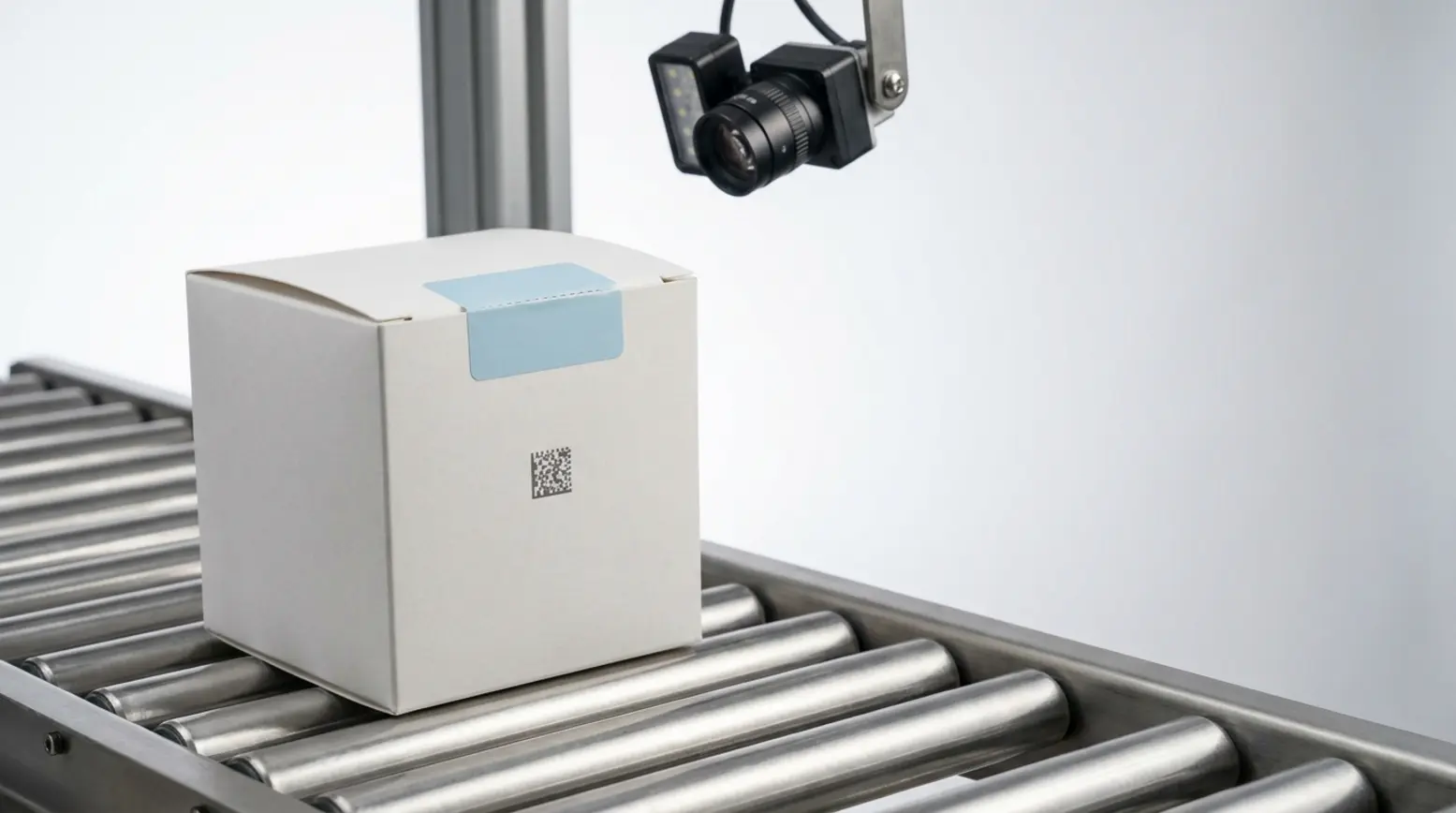

Implementing tamper evidence and serialisation together works best when both features are planned and tested as a single carton system. The unique identifier checks the identity of an individual pack using a machine-readable code, while the anti-tampering device provides a physical sign indicating whether the carton has been opened or altered. Both features can sit on the same carton, but they frequently affect each other. Therefore, teams should concurrently review the print area, quiet zone, seal position, camera access, opening logic, reject handling, and transport stress, before finally testing the completed pack on the intended production line.
Ecobliss builds FMD-compliant serialisation into its pharmaceutical contract packaging, so packs leave verified and traceable.
• The unique identifier and the anti-tampering device serve as separate checks; one feature does not replace the other.
• A carton can easily pass an artwork review yet still fail at full line speed, since code reading and physical opening behave differently in actual production environments.
• Common risks include placing a seal over the code area, adding a feature that blocks camera inspection, leaving a flap unprotected, or discovering weaker tamper evidence after transport.
• While the EN ISO 21976 packaging standard offers useful guidance for tamper-verification features, it does not replace binding legal requirements in Europe.
• The safest approach is straightforward: test both features simultaneously on the final pack and intended line, ensuring that transport checks are included.
Why tamper evidence and serialisation together matter on a single carton
The anti-tampering device and the unique identifier represent separate regulatory obligations for many medicine packs. Although they often appear on the same outer carton, they perform distinctly different jobs. One serves as a data-based identity check for a specific individual pack, while the other provides a physical indication that the pack may have been opened or altered. A scanner reads the code, whereas a person physically inspects the tamper feature. If you need a basic definition first, you can read more about how tamper-evident packaging works before exploring line interaction and pack design in greater detail.
Two checks, two failure modes
A reliable code check relies on print quality, high contrast, rigorous quiet zone control, and a stable camera view of the data matrix at normal production speeds. Conversely, the physical check depends on whether the carton clearly displays signs of opening or alteration after packing, shipping, storage, and use. This is exactly why these features must be reviewed jointly early in the design process. A code might scan perfectly on a flat drawing but fail completely when a pharmaceutical carton seal label encroaches on the clear area. Similarly, a flap might appear fully protected on the artwork, yet still be easily opened from the opposite side in real-world scenarios. Therefore, applying tamper evidence and serialisation together should be treated as a single, practical project, even though the final checks themselves remain entirely separate.
| Feature | What it checks | How it is checked | Where it can fail | Who usually reviews it first |
|---|---|---|---|---|
| Unique identifier | Identity of one individual pack | Scanner and camera inspections | Print area, quiet zone, code contrast, camera access | Artwork, packaging engineering, line team |
| Anti-tampering device | Whether the pack may have been opened or changed | Visual and physical check by a person | Seal area, opening path, transport stress, flap bypass | Packaging engineering, quality, user review |
How tamper evidence and serialisation together work in practice
There is no universal solution when designing tamper-evident packaging for medicines. Some cartons function flawlessly with glued-flap tamper evidence, while others are better suited to a label, a shrink sleeve, or a specially perforated breakable carton construction. Ultimately, the right choice depends on the carton's shape, the specific product, the line setup, the transport route, and the intended opening experience for the patient or caregiver. This is also where the requirements of an EU FMD anti-tampering device become highly practical, as the feature must function reliably on the physical carton and not just on a digital design file.
Teams frequently rely on the EN ISO 21976 packaging standard as a guiding framework for tamper-verification features. This standard is incredibly useful because it supports a highly structured review of physical security measures. However, it does not supersede European legal requirements, nor does it guarantee acceptance for every market or every medicinal product. Regulatory ownership and final market decisions always remain with the customer.
What the code needs
The serialisation code requires a stable print area, sufficient contrast, and a strictly protected quiet zone around the data matrix. Furthermore, the inspection camera must be able to read the code clearly at full line speed. If folds, glossy varnishes, carton movement, or any subsequently added features obstruct that view, readability can plummet instantly. A setup that performs perfectly during a slow machine startup can still fail during normal production runs, simply because increased speed alters timing, viewing angles, and overall pack stability.
What the tamper feature needs
The tamper feature demands an appropriate adhesive area, optimal carton construction, and the ability to display a clear, irreversible sign of opening or alteration. Moreover, the evidence must remain intact and meaningful after extensive handling and distribution. If the structural opening path allows a user to bypass the seal entirely, the anti-tampering device may technically be present but will prove weak in practical application. This is a critical consideration for any pharmaceutical tamper-proof carton concept; the physical signal must remain unambiguous at the end of the supply chain, not just at the end of the packaging line.
Common conflicts when implementing tamper evidence and serialisation together
Most practical failures occur precisely where artwork, carton structure, line inspection, and opening logic intersect. A design might look flawless during a digital review but still fail miserably when real cartons move through a printer, pass under inspection cameras, receive a physical seal, and travel through the shipping network. For this reason, the unique identifier and the anti-tampering device must always be evaluated simultaneously on the finished carton and on the intended production line. In real-world projects, seemingly small modifications often trigger cascading effects, especially when a single carton panel must simultaneously accommodate printing, sealing, folding, and the final opening mechanism.
Seal labels covering the code or quiet zone
A frequent conflict between a tamper seal and a data matrix arises when a seal is placed too close to the code, crosses over it entirely, or breaches the required quiet zone. When this occurs, the camera may reject a perfectly good pack simply because the code area is no longer clean enough for a successful scan. This typically happens following a late artwork revision or a minuscule shift in label positioning. While both areas might appear safely separated on a flat layout, they function as a single, interconnected system on the finished, folded carton.
Tamper features blocking the camera view
Some security features do not obscure the code directly, yet they still interfere with scanning by altering the viewing angle, introducing glossy reflections, or standing proud off the carton's surface. Consequently, camera inspections can become highly erratic at full production speeds, even if the underlying print quality is excellent. Maintaining a reliable camera view of the data matrix depends heavily on the final feature design, the actual substrate, the finished print, and real-world machine conditions. Thus, line trials must utilize the exact carton setup rather than relying on a simplified structural sample.
Cartons opening at an unprotected flap
A carton can suffer a physical failure when one flap is securely sealed, yet another flap can be opened cleanly without leaving a trace. This specific risk is common in glued-flap tamper evidence projects where the glue path protects only a portion of the carton's structural opening route. The result is deceptively simple: the security feature appears intact, but unauthorized access is easily achieved elsewhere. Hands-on opening tests are crucial in this context, as flat drawings rarely reveal how a carton behaves when a person actively grips, bends, and forces it open.
Transport stress weakening the feature
A feature might look pristine prior to shipping but lose its core functionality later due to adhesive limitations, structural carton tension, transit vibrations, compression forces, and repeated manual handling. This is exactly why a thorough transport testing and tamper feature review matters so greatly. Without incorporating realistic transport checks, a pack might leave the production line with clearly functioning evidence, only to arrive at its destination with weakened integrity or confusing physical damage that a patient will find difficult to interpret.
| Conflict | Likely cause | Where it shows up | What to review early |
|---|---|---|---|
| Seal crosses code or quiet zone | Late label move or limited print area | Camera rejects on the packaging line | Code box, quiet zone, final label position |
| Tamper feature affects camera view | Feature height, gloss, angle, carton movement | Unstable inspection at speed | Camera position, lighting, line speed |
| Carton opens from unprotected flap | Wrong opening logic or incomplete seal path | User opening and quality review | Flap design, glue area, opening test |
| Feature weakens after transport | Adhesive limits, carton stress, handling load | Distribution and receiving point | Transport checks, pack stress review |
When these unresolved issues migrate from digital artwork into active production, they instantly become line and pack issues simultaneously. Our secondary contract packaging with serialisation and tamper evidence brings physical packing and precise code control together, ensuring that camera inspections, reject handling protocols, and final batch execution can all be reviewed in one seamless flow. While this integrated approach does not guarantee legal acceptance entirely on its own, it significantly helps engineering teams identify where the primary risks lie before subsequent stages become overwhelmingly complex.
Preventing problems with tamper evidence and serialisation together before line trials
The absolute best time to solve these cascading issues is early in the development cycle, long before validation work becomes burdensome and structural changes become prohibitively expensive. A robust design review should combine carton structure, print layout, component selection, and line setup into one unified discussion. By adopting this holistic approach, teams can verify whether print access remains stable, if the designated adhesive area is truly usable, whether the camera positioning stays reliable, if the reject-handling process makes logical sense, and whether necessary transport checks are properly scheduled. This is the highly practical side of implementing tamper evidence and serialisation together that broad regulatory theory frequently overlooks.
One integrated project review for pack and line
A highly useful review directly connects the original design intent with actual production and distribution realities. Because one minor change can impact several distinct points at once, extreme care is required. For instance, shifting a tamper seal might improve opening clarity while simultaneously reducing critical print access. Altering a carton panel could facilitate better code placement but unintentionally weaken the overall fold strength. Similarly, adjusting the camera's position might boost immediate readability yet expose strict timing limitations elsewhere on the packaging line. Therefore, one comprehensive, shared review typically yields far better answers than conducting isolated artwork and engineering assessments.
Why integrated development helps
We intentionally develop the physical component and the mechanical line setup as a single system because that mirrors exactly how the pack will function in reality. We design explicitly for production, manufacture the necessary packaging components in-house, and provide comprehensive primary and secondary packing services, including integrated serialisation. Should a customer prefer to insource the process, we can even supply the required packaging machinery. Early foundational work on a manufacturable pharmaceutical carton design helps proactively reveal blocked codes, weak tamper evidence, and flawed opening logic well before late-stage changes become significantly harder to manage.
Physical prototypes and real-world line trials are especially invaluable because they vividly demonstrate how the final carton will behave when dynamically erected, printed, sealed, inspected, rejected, packed, and handled at standard production speeds. These trials also confirm whether the integrated tamper evidence and serialisation still function properly after enduring rigorous shipping stress. Ultimately, final approval will always depend upon the complete pack, the specific medicinal product, the customer's overarching plan, and the intended target market.
Tamper evidence and serialisation together in child-resistant cartons
A child-resistant mechanism and an anti-tampering device are not identical features. In a serialized, child-resistant carton, the tamper feature must remain unmistakably clear during the intended adult opening sequence. Seals, mechanical locks, and precise code placement should all proactively help the user understand how to operate the pack, since confusion can easily lead to critical handling errors. Because a highly dense pack architecture automatically increases the risk of negative feature interaction, this specific area demands careful, rigorous review even when the primary carton concept already appears firmly established.
Keep the opening logic clear
The overarching question remains relatively simple: can the intended adult user successfully follow the necessary opening steps while still easily discerning whether the carton was previously opened? This fundamental issue is entirely separate from the concept of child resistance. As just one practical example of integrated design work executed within a dense structural format, you can explore the 168-tablet child-resistant packaging case. This case study brilliantly illustrates why physical layout matters so profoundly, though it should not be interpreted as absolute proof for one specific tamper feature or a universally applicable serialisation layout.
Questions teams ask about implementing tamper evidence and serialisation together
Can a single feature cover both legal requirements?
No. The unique identifier and the anti-tampering device serve entirely separate purposes. One systematically checks product identity through embedded data, while the other verifies physical package integrity. Therefore, a single feature should never be assumed to satisfy both legal obligations simultaneously.
Is a seal label always the best option?
No. While a seal can work exceptionally well, the correct answer firmly depends on the specific carton, the product inside, the production line, the transport route, and the intended user opening experience. In many projects, glued flaps, shrinkable features, or intentionally breakable carton constructions actually prove much more suitable.
Does the EN ISO 21976 packaging standard dictate legal acceptance?
No. The EN ISO 21976 packaging standard provides excellent guidance for tamper-verification features and effectively supports internal requirement setting. However, it does not replace strict European legal requirements, nor does it automatically guarantee regulatory acceptance for every medicine or across every individual market.
When should we test the final design?
Teams should rigorously test both features together on the finalized pack and the intended packaging line, ensuring that real-world transport checks are fully included. They should absolutely not test them purely as isolated, digital artwork elements, because many critical failures only materialize when the fully assembled carton runs at production speeds and subsequently travels through physical distribution channels.
Next steps for design review
The prevailing practical rule is simple: physically test both features together on the final pack and on the intended production line. This essential testing phase should always encompass code readability, seal functionality, structural opening logic, automated reject handling, and comprehensive transport checks. If you want to make your internal discussion significantly more concrete, you can request a pharmaceutical packaging sample to review folds, panels, and proposed seal placements intimately by hand. Examining a physical sample tremendously helps teams discuss realistic packaging behavior, though the final qualification will always depend on the exact component specifications, the medicinal product, the active production line, and the ultimate transport plan.
Request a free sample now!