
Temperature-controlled packaging is the layer of the supply chain that keeps a vaccine at 4 degrees from a factory in Belgium to a clinic in Brazil. The stakes are simple: thermal excursion can degrade the API, invalidate the batch, and trigger a deviation report that takes a quarter to close. The technology is mature in 2026, but the implementation details still trip up most launches.
When temperature control matters
Most stable solid orals don't need it. Tablets in standard blister packs ship at room temperature without special handling. Where temperature control becomes critical:
Biologics and vaccines. Monoclonal antibodies, insulin, mRNA vaccines, viral vector vaccines. Stability ranges typically 2-8 degrees Celsius, sometimes -20 or -70 for specialty products.
Hormone therapies. Sensitive to room temperature excursions in summer or in tropical markets.
Specialty oncology. High-cost APIs where a single batch loss is a six-figure problem.
Clinical trial supplies. Particularly for first-in-human studies where the API is unstable enough that ambient shipping isn't validated yet.
The three temperature-control approaches
Active solutions
Refrigerated containers, powered shippers, refrigerated trucks. The container actively maintains temperature using mechanical cooling. Used for high-value, long-distance shipments where the cost of failure outweighs the cost of equipment.
Passive solutions
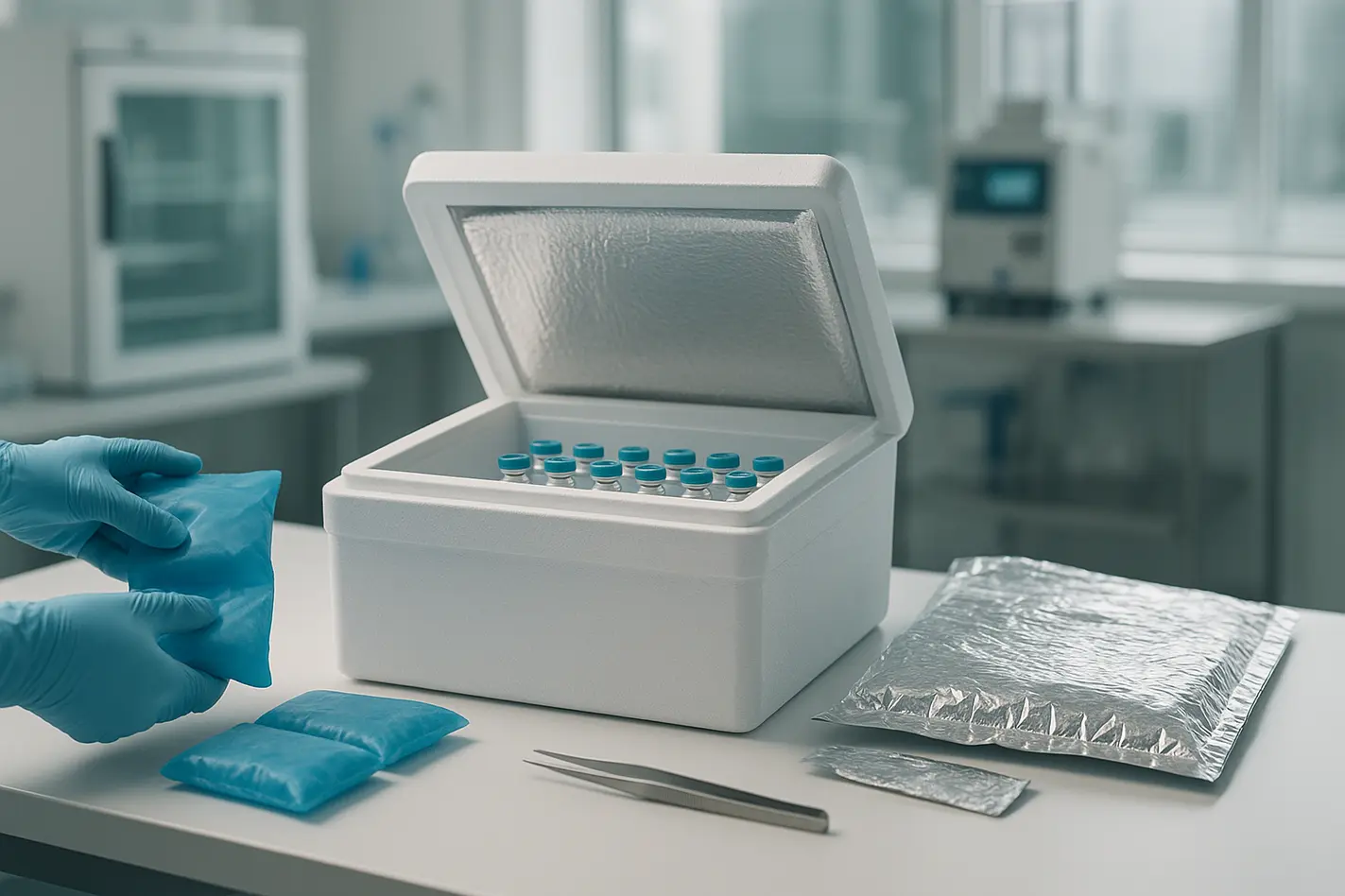
Insulated boxes with phase change materials (PCM) or gel packs. The container holds temperature by thermal inertia rather than active cooling. Cheaper than active, validated to specific lane profiles, the standard for last-mile clinical and commercial distribution in EU markets.
Hybrid solutions
Combination of active and passive elements, often with electronic temperature monitors and data loggers for full audit trail. Used for the most demanding lanes (transcontinental cold chain, ultra-low-temperature mRNA distribution).
Where lane qualification breaks
Most temperature-control failures aren't equipment failures, they're lane qualification gaps. The pack performs perfectly under standard test conditions and then fails on a real shipment because:
- The route includes an unexpected layover at a warm warehouse.
- Summer ambient temperatures in the destination market exceed the test profile.
- Customs delays add 24 hours that wasn't in the validation.
- The receiving site stores the pack in a corridor instead of a fridge over the weekend.
Robust lane qualification accounts for the worst-case scenarios, not just the average.
Cold seal blister wallets and temperature
Cold seal blister wallets sidestep one specific temperature problem: the API never sees heat during the wallet bonding step. Cold seal packaging uses pressure alone instead of heat, which protects biologics and other heat-sensitive APIs during pack assembly.
For the post-assembly cold chain, the wallet sits inside the same temperature-controlled secondary or tertiary packaging as any other pharma format. The wallet itself isn't the temperature-control layer.
Regulatory side
Temperature-controlled packaging falls under GDP (Good Distribution Practice), USP, Ph.Eur., and ICH guidelines. Validation typically includes lane qualification, container performance under summer/winter profiles, and excursion handling procedures. EU GDP audits look closely at the lane qualification documentation and the temperature monitoring data.
If you're scoping temperature-controlled packaging
The conversation starts with the API stability profile and the target geography. From there we work backward to the secondary packaging, the tertiary configuration, and the cold chain partner. Send us the brief and we'll work through the trade-offs.
Request a free sample now!